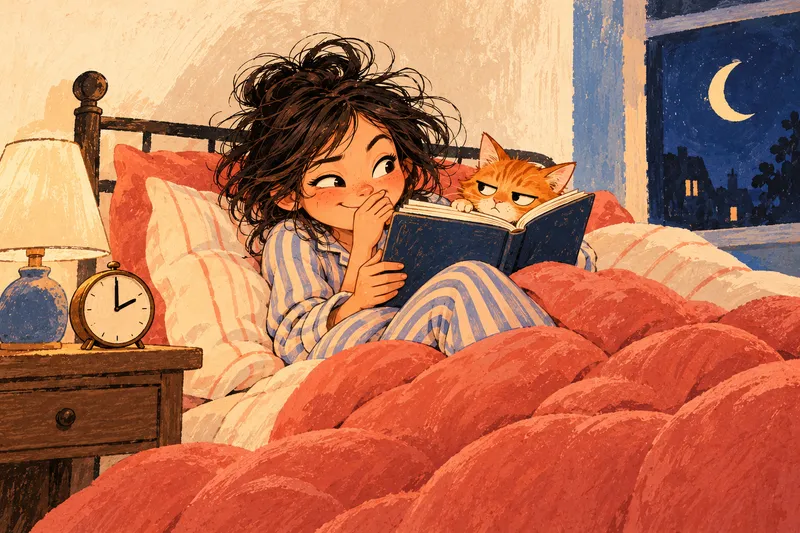
I finished Funny Story at the end of a week and kept turning it over for days afterwards. That's usually a good sign, even when a book frustrates me a little. This one did, in places.
If you haven't read it: Daphne loses her fiancé to his childhood best friend, ends up sharing an apartment with that best friend's ex, and slides into exactly the kind of fake-dating arrangement you'd expect from there. That's the premise. It isn't what the book is about.
What it gets right
Daphne and Miles work because Henry never rushes them. They happen on unremarkable Tuesday nights, in arguments about grocery lists, under a bird that will not stop screaming outside their window, and the ending is earned the slow way. Miles is charming without turning into a fantasy, which is harder to write than it looks. The dialogue is some of Henry's sharpest, and the banter never plays to an audience.
The real achievement is Daphne herself. She doesn't simply get over Peter. She builds a life that has nothing to do with him: a friendship with a coworker, a job she cares about, opinions that don't pass through a man first. The library helps. Henry treats it as the place people go when they're lonely on purpose, and that's one of the truest things I've read about adult loneliness in a long while.
The thing that stayed with me
Early on, Daphne says she loved the way Peter told the story of how they met. It was his version, in his voice, and she lived inside it happily for years, until it stopped including her.
Now look at how the book is told. Every page is Daphne, first person, present tense. No second narrator, no chapters from Miles. A woman who spent years inside someone else's telling of her life finally gets to tell it herself, as it happens. The form does the same work as the plot. I only noticed it halfway through, and after that I couldn't stop seeing it.
Where it doesn't land
The single point of view that makes that work is also what the book pays for it. We only see Miles through Daphne, so his grief, his history with Petra and most of his inner life stay a little out of focus. Maybe that's deliberate. Maybe it's just a gap. Peter and Petra fare worse: they exist mostly as a wound Daphne has to heal from, never as people whose version of events might complicate hers. One scene from Petra's side, not a redemption arc, just a moment where her logic makes sense from the inside, would have made Daphne's forgiveness feel earned instead of assumed.
The ending is the other soft spot. For a book so wise about how slow and unglamorous healing is, the last thirty pages tie up the family conflict a little too neatly. It's the one place Funny Story trades its own values for a tidier finish.
What I'd have changed
Two things, and neither touches Daphne's voice, which I wouldn't trade. Let Miles tell a few funny stories of his own, the way the title promises, instead of mostly reacting to hers. He gets one long speech late in the book. He needed three or four small ones earlier, so we know him before we're asked to trust him. And loosen the ending by one thread. A book this clever about messy healing had earned a slightly messy last page.
So, should you read it?
Yes, if you want warmth more than laughs. It's sharp where it matters, and moving about what it means to stop living inside someone else's version of your life. It's also a little too well behaved in the places where the title promised chaos. Not the funniest thing Henry has written. Maybe the most honest.
Where does Funny Story sit among your Emily Henry books? And if you loved it, tell me what you'd put next to it on the shelf.
I read, I choose, and I write about the books that stay with me. I also write The Keeper Chronicles.
A weekly letter for people who love books.
Once a week: a short personal note, one article about reading or family life, one practical idea to try, and a question you can answer just by replying. One email a week, never a sales pitch.
No comments yet. Be the first to say something.